
AFTER STEVE CHU, WHO IS GOING TO BE NEXT?
Soon to be disclosed!
Next “discussion marathon” with another international master is scheduled for 2027
SEE YOU IN MILAN IN TWO YEARS
The appreciation for Chu’s course, held in 2025, has promped Stefano Gracis to organize another edition of “Open discussion” which will also be held in Milan in 2027. Stefano has not yet announced the name of the speaker.
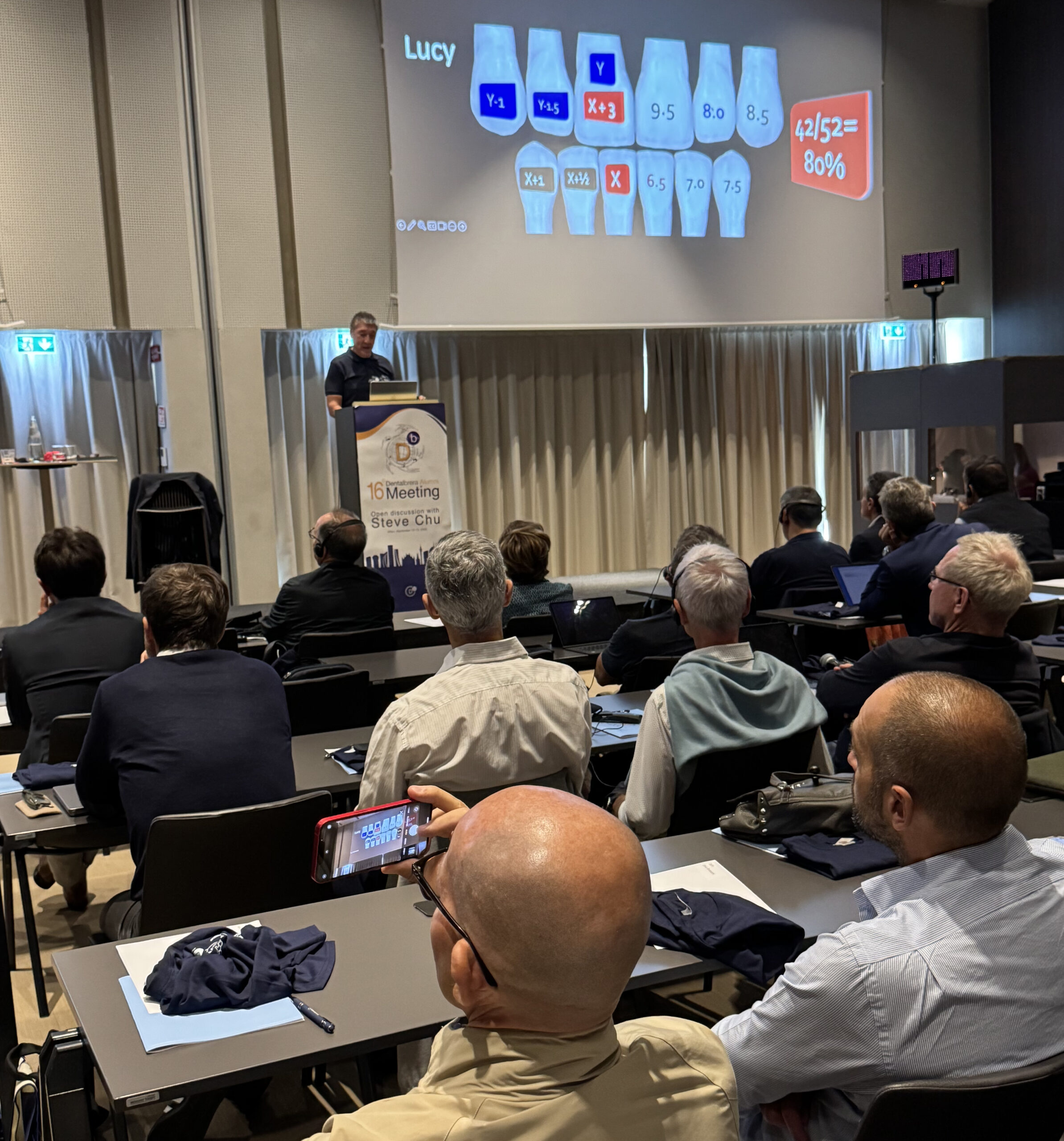
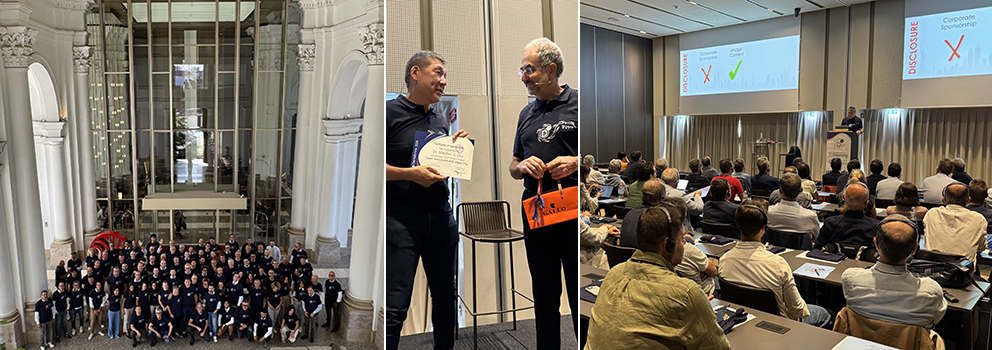
After many years away from Italy, Steve Chu returned to our country at the invitation of Stefano Gracis to lead a two-day master class. Steve addressed some of the key points of his vision of aesthetic dentistry, engaging in constant dialogue with Stefano and an audience divided between young dentists and more experienced professionals, as well as a representation of highly trained dental technicians, including from abroad.
Friendship and mutual respect fostered the exchange between Steve and Stefano on stage, also amplifying the participants’ contributions. Starting with some of his most complex cases, Steve shared with the audience the strategies he uses to successfully address difficult situations, highlighting some “golden rules” that should be a constant reference for those working in aesthetic dentistry.
Participants had the rare opportunity to speak and discuss the topics presented face-to-face with Steve and Stefano, following a horizontal and equal comparison model with the speakers, and alternating moments of frontal lecture with a real debate.
READ STEVE CHU’S CV
A Winning formula based on direct discussion
The course unfolded in three main sessions (summarized below), each addressed through the discussion of exemplary clinical cases. The course’s original format fostered a lively debate between the speaker and audience from the very beginning, which contributed to the event’s success.
We have therefore decided to propose a second “Open Discussion” with an internationally renowned speaker, whom Stefano Gracis will invite to Italy for the next edition of a debate marathon. The name is still top secret, the location will once again be Milan, and the year will be 2027.
The “Open Discussion” is open to clinicians and technicians
FOLLOW US FOR ALL DETAILS
Let's retrace the topics of the three sessions addressed by Steve Chu

Part 1 - Tooth size and shape: using biometrics in treatment design

Part 2 - Immediate tooth replacement in the esthetic zone: understanding biology, risks and rewards


Part 3 - When to remove or save and remediate implants in the esthetic zone

CONCLUSIONS
PART 1 – Tooth size and proportion
• Lower central incisor (X) most consistent and reliable tooth to determine whether other anterior teeth are of the correct size
• Algorithm:
-mandibular central incisor X —> maxillary central incisor X+3mm=Y
-mandibular lateral incisor X+0.5mm; mandibular canine X+1mm
-maxillary lateral incisor Y-2mm or Y-1.5mm;
-maxillary canine Y-1mm mandibular canine = maxillary lateral incisor
• Tooth proportions (width/height):
-80% for Caucasians
-about 70% for Asians
-Biologic males have larger teeth than females
-No gender differences for shape
PART 2 – Implant placement
• Minimum age for implant placement: no universal agreement, but long-faced females are at higher risk for infra-occlusion—> wait for implant placement as long as possible
• Avoid apical perforation of the bone and buccal placement
• In immediate post-extraction placement, make sure to seal the socket with the provisional or with the healing abutment (likely to be custom made)
• Choosing an implant system: for anteriors, implants with platform switch to better preserve tissues; for posteriors, favour implants with strong connections and wide area to distribute occlusal forces (therefore, ok also non-platform switched implants)
PART 3 – Remediation of ailing implants
• First, determine if implant is restorable
• If prosthetic axis is in the cervical third (inclination of 30° or more)—> not maintainable
• Probe sulcus: If implant affected by periimplantitis —> not maintainable
• If restorable, the diagnostic key is the palatal level of the gingiva:
• If it is at the level of proximal papillae —> surgeon can fix the recession and lack of buccal tissues in a highly predictable way
• If it is more apical —> a triple-layer graft is indicated
• Replace the existing crown with narrow and thin abutments, flat in the cervical portion
• Only if the implant has midfacial recession, decoronate the implant placing a cover screw for a few weeks; if no recession, place provisional with ideal shape
• Crowns (provisional and definitive) need to be highly polished in the tunnel
• Limit of ASC (Angulated Screw Channel) is generally 15° when considering possibility to apply the proper torque, but it depends on the system